Fulvic acid effect, use and side effects
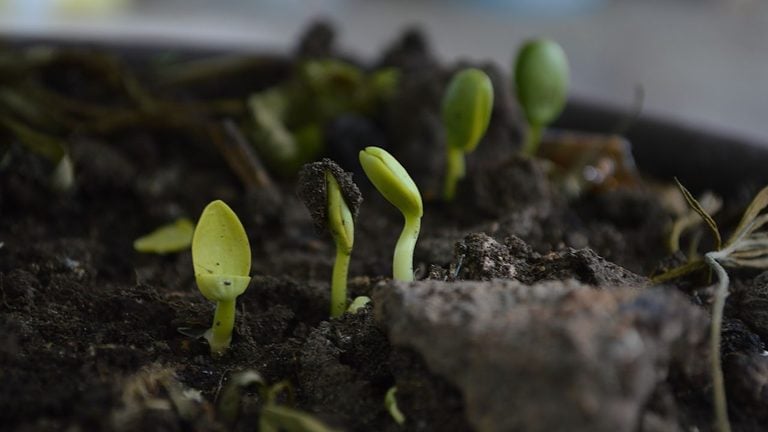
Fulvic acid, also known as fulvic acid, is one of the most interesting natural humic substances. It is produced by the microbial decomposition of plant matter in the soil and is often considered in connection with mineral binding, chelation, bioavailability, cell metabolism and natural excretion processes.
In our modern world, many people are looking more closely at natural nutrition, intestinal flora, digestion, dietary fibre, environmental factors and the quality of food supplements. Fulvic acid fits perfectly into this context because it is a natural component of humus processes and can form complexes with minerals, trace elements and certain organic molecules.
This article explains what fulvic acid is, how it differs from humic acid, what properties are discussed, what you should look out for when using it and what possible side effects are known.
You can find a liquid formulation with fulvic acid in Fulvicherb Synergy. Fulvic acid is combined with inulin, pectin, arginine, niacinamide, natural unrefined rock salt, sunflower lecithin and other carefully selected ingredients.
Briefly explained: What makes fulvic acid special?
Fulvic acid is a natural component of humic substances. It is formed when microorganisms break down plant material in the soil. Compared to humic acid, it has smaller molecules and is soluble in water at any pH value.
- belongs to the humic substances
- is created by natural humus processes in the soil
- is soluble in water at any pH value
- has a low molecular weight
- Can form complexes with minerals and trace elements
- is often considered in connection with bioavailability, chelation and mass transport
- also occurs in Shilajit and Mumijo
- is a central component of Fulvicherb Synergy
What is fulvic acid?
Fulvic acid, also known as fulvic acid or fulvine, is one of the most important fractions of humic substances. Humic substances are formed when plant material, microorganisms and organic substances are broken down and transformed in the soil over long periods of time.
This process is very slow and can take place over many years or even centuries. The resulting organic substances are of great importance for soils, plants, microorganisms and natural material cycles.
Fulvic acid has a low molecular weight and is soluble in water. This clearly distinguishes it from larger humus components. It is often described as a natural chelating and complexing agent because it can bind minerals, trace elements and certain organic molecules.
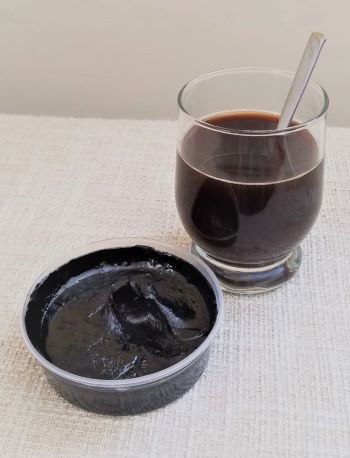
The well-known natural substance Shilajit, also known as mumijo, naturally contains humic substances, including fulvic acid. Quality is always important: the origin, purity and controlled processing are particularly crucial for shilajit and humic substance products.
Is fulvic acid one of the humic substances?
Humic substances are produced by the biological decomposition of biomass and are found in soils, sediments and groundwater, among other things. The soluble components of these humic substances include humic acids and fulvic acids.
Fulvic acid is the smaller and more water-soluble fraction. It contains functional groups such as carboxyl groups and hydroxyl groups that can react with other inorganic and organic substances.
It is precisely this structure that makes fulvic acid an interesting natural molecule in the context of mineral transport, bioavailability, complex formation and modern food supplements.
Fulvic acid vs. humic acid: the most important differences
Fulvic acid and humic acid both belong to the humic substances. Nevertheless, they differ significantly in molecular size, solubility and typical function.
| Feature | Fulvic acid | Humic acid |
|---|---|---|
| Molecule size | smaller | larger |
| Solubility | Soluble in water at any pH value | Particularly soluble in alkaline environments |
| Structure | smaller, reactive molecules | Larger, more complex humus structures |
| Typical focus | Mineral binding, bioavailability, complex formation | Soil structure, humus, binding in the soil and intestines |
The Main difference between humic acids and fulvic acids lies in their chemical composition and molecular size. Humic acids have larger molecules and a more complex structure. Fulvic acids are smaller and more easily soluble.
Humic acids are particularly soluble under alkaline conditions. Fulvic acids, on the other hand, are water-soluble in both acidic and alkaline environments.
This enables them to bind, transport and release substances in different environments. It is precisely this property that makes fulvic acid particularly interesting for natural formulations.

Natural sources in soil and water
Fulvic acid is naturally present in healthy, humus-rich soils. It is produced by microbiological processes and is continuously formed in the natural material cycle.
Today, however, many soils have been altered by intensive agriculture, leaching, fertilisers and chemical pollution. As a result, the humus content, soil microbiome and natural humic substance formation can be impaired.
The role of microorganisms
Microorganisms are crucial for the formation of humic substances. If the microbial diversity in the soil decreases, the natural formation of valuable soil organic matter can also decrease.
A lower humus content often also means that plants can absorb fewer natural accompanying substances and nutrient complexes. This is why humic substances are once again gaining importance in both agriculture and nutrition.
Springs, streams and humus-rich soils
Fulvic acids occur more frequently in water bodies than humic acids. Natural water can contain humic substances if it has flowed through forest soil, humus layers or mineral-rich soils.
Natural watercourses are fed by rainfall, mountain slopes and humus-rich soils. This allows water-soluble organic soil components to be dissolved and transported into the water.
The transport molecule of nature
Fulvic acid is often described as a natural transport molecule. Due to its structure, it can react with many different compounds and form complexes.
This ability is particularly interesting because certain plant-based ingredients, minerals or trace elements can be better integrated into natural material systems in complexed form.
In modern nutritional concepts, this property is therefore considered in connection with mineral transport, bioavailability and the combination of natural ingredients.
Chelation and mineral binding
One of the most important processes in which fulvic acid can play a role is the Chelation. Metal ions such as magnesium, zinc or iron can be bound and present in a water-soluble form.
Fulvic acid contains functional groups, including carboxyl groups and aromatic hydroxyl groups. These molecular regions can form chelate and complex bonds with metals and certain organic molecules.
This property is particularly interesting because chelate-bound compounds are often considered in connection with mineral absorption, substance binding and natural bioavailability.
Why natural chelating agents are interesting
Natural chelating agents and complexing agents can bind different substances and are available in water-soluble form. As a result, they are particularly discussed in connection with minerals, trace elements, certain metal ions and natural excretion processes.
- They can bind minerals in complexed form.
- They are soluble in water and have a low molecular weight.
- They are often considered in connection with bioavailability and substance transport.
- They can form complexes with certain metal ions.
This combination of water solubility, small molecular size and ability to form complexes makes fulvic acid an interesting natural ingredient in modern formulations such as Fulvicherb Synergy.
Heavy metals, cation exchange and quality
There is frequent discussion on the internet as to whether fulvic acid can bind or transport heavy metals. The decisive factor here is the difference between natural and synthetic chelating agents and the respective chemical environment.
In the specialist literature, fulvic acid is primarily considered in connection with cation exchange, metal bonding and natural substance complexation. Various factors can play a role here, including pH value, ion size, bond strength and the chemical structure of the respective metal.
It is important to note that fulvic acid is not a medical detoxification agent and is not a substitute for therapy. Anyone who is specifically concerned with heavy metals, stress or complaints should seek medical advice. For a more detailed classification, you can find the supplementary article on Fulvic acid, natural excretion processes and mineral binding.
Fulvic acid, intestinal flora and digestion
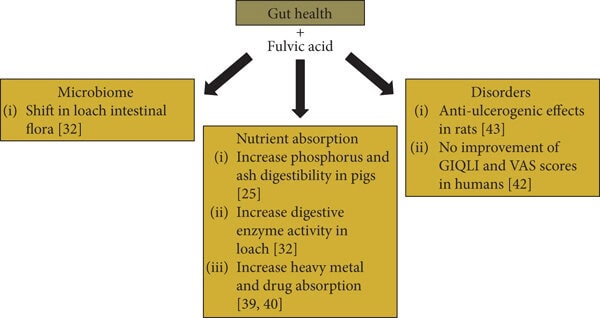
Fulvic acid is also considered in connection with digestion and intestinal flora. Of particular interest here is its role as a complexing agent and natural component of a formulation that also contains prebiotic fibre.
In Fulvicherb Synergy Fulvic acid is combined with inulin and pectin. These soluble fibres are often mentioned in connection with intestinal flora, fermentation and a fibre-conscious diet.
If you are more interested in dietary fibre, you will also find Apple pectin with inulin and Pure apple fibre.
Modern nutrition, additives and natural ingredients
Fulvic acid is also receiving more attention again today because many people are concerned with modern nutrition. This includes highly processed foods, additives, artificial sweeteners, refined carbohydrates, low fibre intake and a change in the quality of many foods.
Fulvic acid is not a substitute for a balanced diet. However, it is suitable for people who are concerned with natural ingredients, mineral retention, intestinal flora, digestion and a conscious diet.
It is particularly useful not to consider fulvic acid in isolation. Fibre, fluids, high-quality foods, herbs, micronutrients and an overall conscious diet also play a role in everyday life.
Which properties are being discussed?
Fulvic acid is being investigated in various scientific and nutritional contexts. These include mineral transport, antioxidant properties, cell metabolism, intestinal flora, heavy metal binding and natural excretion processes.
It is important to note that this humic substance is not a miracle cure and does not replace medical treatment. However, it is an interesting natural ingredient for people who are interested in bioavailability, natural ingredients and modern nutrition.
Antioxidant properties and cell metabolism
Fulvic acid is often considered in connection with antioxidant properties. Antioxidant processes play a role in the body when it comes to free radicals, cell metabolism and natural protective mechanisms.
A scientific article describes humic substances in connection with inflammation-related processes and oxidative stress, among other things.
Brain, nervous system and Shilajit research
Fulvic acid is also discussed in connection with mental performance and the nervous system. One Study from the year 2011 describes them in the context of neuroprotective properties.
More Studies on Shilajit consider fulvic acid to be an important component that is discussed in connection with cognitive function and neurobiological processes.
Skin, hair and external appearance
Fulvic acid is also discussed in connection with skin, hair and external appearance. The main focus here is on antioxidant properties, mineral binding and natural metabolic processes.
Many people are interested in this ingredient because they prefer natural ingredients and would like to consciously supplement their diet with minerals, trace elements and plant-based accompanying substances.
Fulvicherb Synergy: liquid formula with fulvic acid
Fulvicherb Synergy uses fulvic acid as the central component of a liquid formula. The formula combines it with inulin, pectin, arginine, niacinamide, natural unrefined rock salt, sunflower lecithin and other carefully selected ingredients.
Fulvicherb does not rely on an isolated single ingredient, but on a well thought-out combination of natural ingredients. The result is a liquid formula for people who want to supplement their diet with fulvic acid, prebiotic fibre and micronutrients.
This composition is particularly interesting for all those who deal with the following topics:
- Fulvic acid and natural humic substances
- Minerals and trace elements
- Prebiotic fibres such as inulin and pectin
- Intestinal flora and digestion
- Conscious nutrition and modern environmental factors
- Liquid food supplement instead of capsules or powder

Arginine complex in Fulvicherb Synergy
Fulvic acid is also interesting because it can form complexes with certain organic molecules. In Fulvicherb Synergy arginine is present as a fulvic acid-arginine complex.
Arginine is an amino acid and is considered in the body in connection with the formation of nitric oxide, or NO for short. NO is a signalling molecule and is often associated with blood vessels, smooth muscles, circulation and metabolic processes.
In this article, however, arginine remains a supplementary aspect. The main focus is on fulvic acid as a natural humic substance. You can find out more about the composition on the page Fulvic acid-arginine complex.

Role in agriculture
In today's agriculture, intensive soil use, fertilisers, pesticides and leaching often lead to nutrient losses. Natural sources of humic substances therefore also play an important role in plant production.
As a chelating agent, fulvic acid can bind minerals such as iron, zinc or magnesium and make them more available to plants. In agriculture, it is also considered in connection with soil fertility, root growth, photosynthesis and stress tolerance of plants.
Due to modern environmental pollution and changes in soil quality, the targeted study of humic substances is also becoming increasingly important in this area.
Is it safe to take?
The safety of fulvic acid depends heavily on its origin, purity, processing and dosage. Possible contamination with heavy metals is often discussed, particularly in the case of shilajit or mumijo products. It is therefore important to ensure controlled quality, clean raw materials and transparent production.
Fulvic acid itself is often considered in connection with natural chelation and complex formation. However, inferior or uncontrolled products can be problematic if they come from contaminated sources or are not sufficiently tested.
Anyone wishing to use a dietary supplement should therefore pay attention to a controlled formulation, clear dosage recommendations and a reputable source.
Possible side effects and instructions for use
Fulvic acid can be tolerated differently depending on product quality, dosage and individual sensitivity. Sensitive individuals may initially experience gastrointestinal reactions such as soft stools, nausea or an unfamiliar abdominal sensation.
Particularly in the case of existing illnesses, regular use of medication, pregnancy, breastfeeding or known mineral metabolism disorders, the intake should be clarified by a doctor beforehand.
Product quality is also important: shilajit and humic substances should come from controlled sources and be tested for heavy metals and microbiological contamination wherever possible.
What should you look out for in fulvic acid products?
Not every fulvic acid or shilajit product is the same. The decisive factors are origin, processing, purity and transparent quality control.
- Controlled origin of the raw materials
- Gentle processing
- Clear dosage recommendation
- Testing for heavy metals and impurities
- No exaggerated promises of a cure
- Reliable, comprehensible product information
- Transparent information on the composition
According to the manufacturer, a fulvic acid raw material is used for Fulvicherb in pharmaceutically pure quality is used. As a result, the ingredient fits into a controlled liquid formulation in which purity, processing and composition play a central role.
You can find out more about the technological background of the formula on the page A patented technology.
Frequently asked questions about fulvic acid
What is fulvic acid simply explained?
Fulvic acid is a natural component of humic substances. It is formed during the microbial decomposition of plant matter in the soil, is water-soluble and can form complexes with minerals and trace elements.
What is the difference between fulvic acid and fulvic acid?
Fulvic acid and fulvic acid refer to the same substance. In German, fulvic acid is usually used, while fulvic acid is also used as a name.
What is the difference to humic acid?
Fulvic acid has smaller molecules and is soluble in water at any pH value. Humic acid has larger molecules and is particularly soluble in an alkaline environment.
Is fulvic acid the same as shilajit?
No. Shilajit is a complex natural resin that may contain fulvic acid, among other things. Fulvic acid is an important component of certain shilajit products, but is not identical to shilajit.
What role does fulvic acid play in intestinal flora and digestion?
Fulvic acid is considered in the context of natural substance systems and complex formation. In Fulvicherb Synergy it is also combined with inulin and pectin, two soluble dietary fibres that are often mentioned in connection with intestinal flora, fermentation and a fibre-conscious diet.
Can products with humic substances contain heavy metals?
Products can vary in purity depending on their source and processing. Controlled origin, clean processing and testing for heavy metals are therefore particularly important.
When should you be careful?
In the case of pregnancy, breastfeeding, regular medication, existing illnesses or known sensitivity, the intake should be clarified by a doctor beforehand.
Conclusion: Why fulvic acid is so special
Fulvic acid is a natural component of humic substances and is produced by microbiological processes in the soil. Its solubility in water, its low molecular weight and its ability to form chelates and complexes make it particularly interesting for modern nutritional concepts.
It is often considered in connection with mineral transport, bioavailability, natural excretion processes, cell metabolism, intestinal flora and the combination of micronutrients.
In Fulvicherb Synergy Fulvic acid is combined in pharmaceutically pure quality with arginine, inulin, pectin, niacinamide, natural unrefined rock salt and other carefully selected ingredients - as a liquid formula for people who want to consciously supplement their diet.
 English (UK)
  Deutsch
  Italiano
  Français
  Español
  Polski
  Slovenčina
  Română